
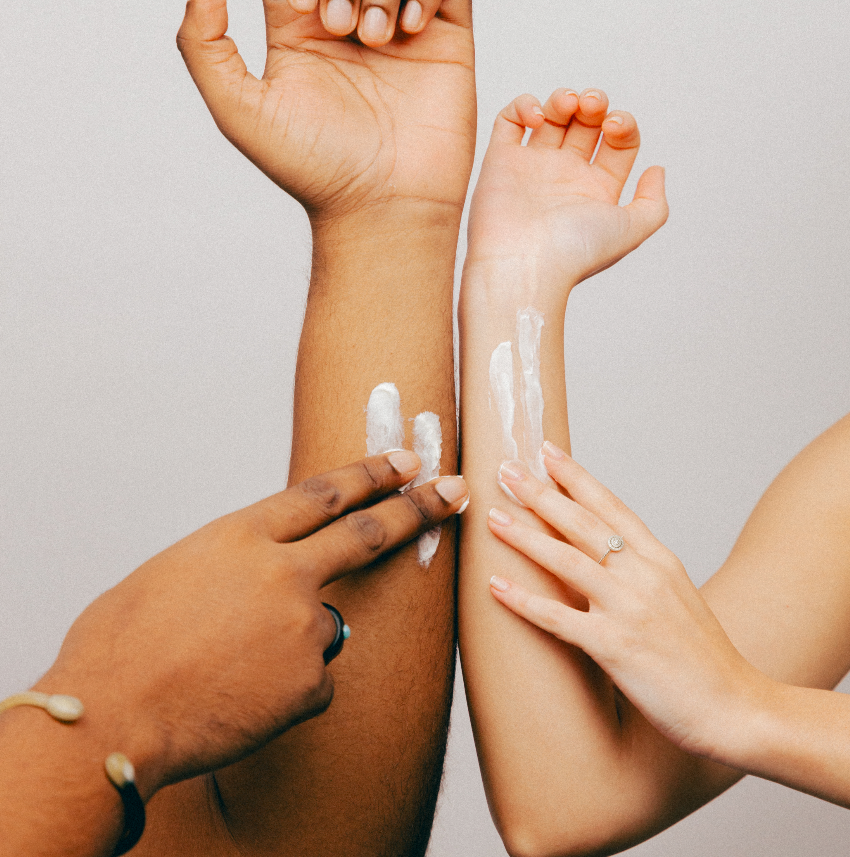
Applying sunscreen is essential to protect our skin from UV rays and prevent diseases like skin cancer. However, it's important to apply it correctly to get adequate protection. In this article, we share the steps for correctly applying sunscreen, backed by scientific studies.
Extreme sun exposure
Exposure time matters: spending several hours in direct sun, especially at midday, can exceed the protective capacity of any SPF. The environment also plays a role: on beaches, snow, or water, there is additional reflection that increases radiation.
Choose a sunscreen suitable for your skin type.
According to a study published in the journal Dermatologic Clinics, sunscreens containing titanium dioxide and zinc oxide are the most effective in protecting against UVA and UVB rays. Additionally, make sure to choose an SPF (sun protection factor) appropriate for your skin type. For example, for sensitive skin, an SPF of 30 or higher is recommended.
Apply enough.
Many people do not apply enough sunscreen, which reduces the effectiveness of protection. According to a study published in the journal Acta Dermato-Venereologica, the adequate amount of sunscreen is 2 milligrams per square centimeter of skin. This means that to cover the entire body of an average adult, at least 30 grams of sunscreen are needed.
If you use ours, this is equivalent to half to a shot glass depending on your body size.
Apply sunscreen before going out in the sun.
According to a study published in the journal Photochemistry and Photobiology, sunscreen should be applied at least 20 minutes before sun exposure for the skin to absorb it properly.
Reapply sunscreen every 2 hours.
Sunscreen protection decreases over time, so it needs to be reapplied every 2 hours, or after swimming or sweating. According to a study published in the journal Photodermatology, Photoimmunology & Photomedicine, sunscreen protection can decrease by up to 50% after 2 hours of sun exposure.
-
Sunscreen degrades with sun exposure, sweat, friction, or water.
-
The recommendation is to reapply every 2 hours/80 minutes and always after swimming, sweating, or towel drying.
-
Although zinc is mineral and more stable, the protective film still breaks down.
Make sure to apply sunscreen to all exposed areas.
Often, we forget to apply sunscreen to areas like the lips, ears, and feet. According to a study published in the journal Photochemistry and Photobiology, these areas are particularly susceptible to UV damage.
-
Often, areas are left uncovered: ears, scalp, bikini line, feet, hands, upper back.
-
If the application is not uniform, UV rays find "windows" to penetrate.
Other external factors
-
Sweat, clothing friction, or sand remove the product.
-
Not waiting the necessary minutes after application before sun exposure.
-
Using expired or poorly stored sunscreen (excessive heat, container open for too long).
Remember that correctly applying sunscreen is essential to protect your skin from UV rays and prevent diseases like skin cancer. If you still haven't found the right sunscreen for you, we invite you to try our sunscreen formulated with 23.4% non-nano zinc oxide, which acts as an excellent protective layer for the skin. Enriched with hyaluronic acid, antioxidants, and coconut derivatives; it works for sensitive skin, with the highest SPF rating (50+), which includes any value from 50-100.
Protect your skin and buy our sunscreen today!
References:
Lim HW, et al. Photoprotection. Dermatol Clin. 2014;32(3):281-97.
Diffey BL. When should sunscreen be reapplied? J Am Acad Dermatol. 2001;